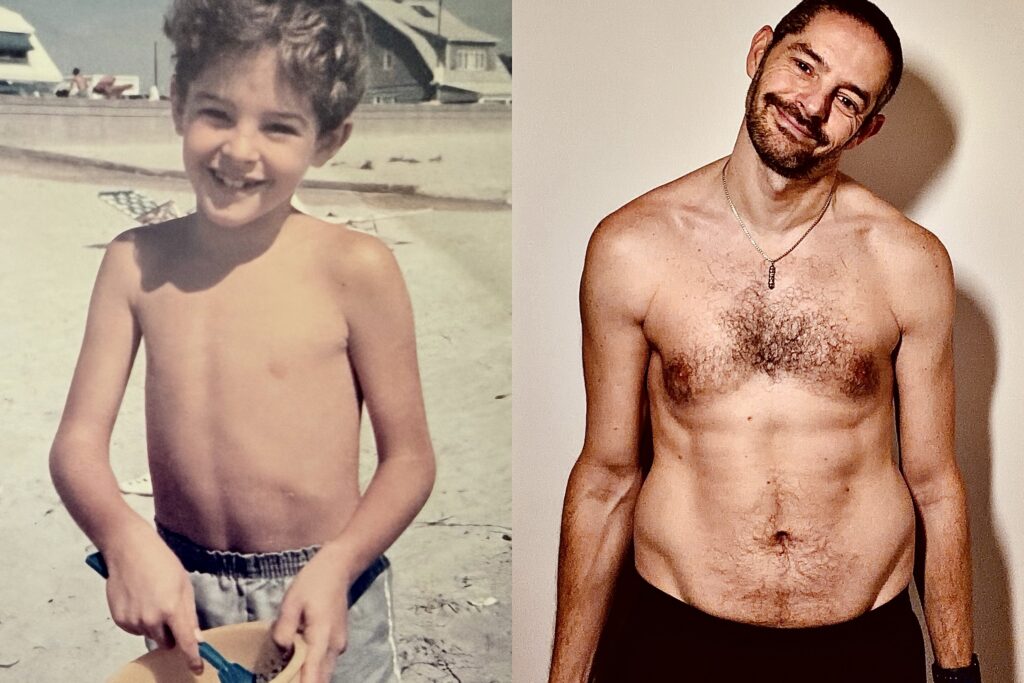
My wife likes organizing things. She’s good at it. Recently, she decided to go through a bunch of old photos we have, both of her family and mine. During that process, she came across a large batch from my family and asked me to organize those.
There were a bunch of photos of me when I was young starting from when I was a baby all the way through high school. Among other things, the photos did a nice job of reminding me that I have always had very curly hair. If you only met me in the past 3 decades, you probably wouldn’t know that because I keep my hair cut very short.
Anyhow, there was one photo that jumped out to me more than the others. This photo:
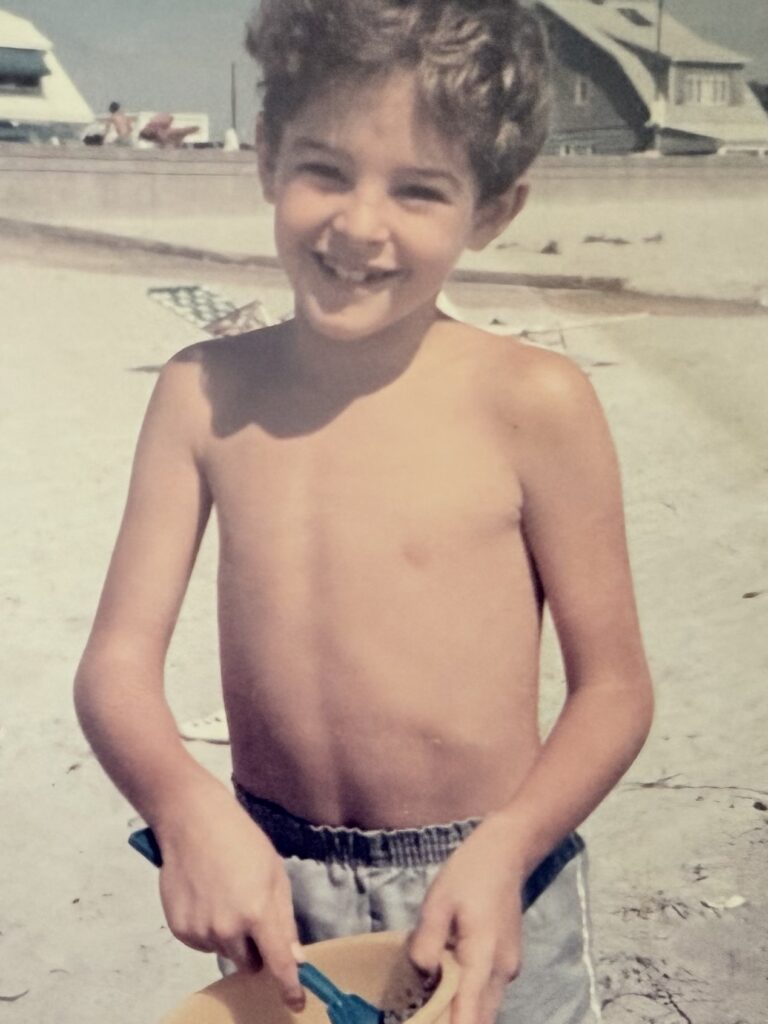
I was probably around seven or eight years old and clearly on a beach. I was wearing a super-cool shorts/bathing suit styled perfectly for the early-to-mid 80s and was apparently in the middle of some sort of sand-based construction situation. None of those things stood out to me though. The thing that stood out to me was that I think this was the last photo of me shirtless, at least that I’m aware of, in decades.
While the specific day that this photo was taken was likely not the beginning of my body self-consciousness, it is a marked point in time.
How about I give you a bit of context?
I’ve written three books. The second one I wrote is called “The Paradox of Fine: A Midlife Health Transformation” which you can find here. You can read the synopsis on Amazon but in short, it’s a book about how I discovered that I wasn’t as healthy as I thought I was and had gotten complacent. It’s a story about what I did to make improvements to my life and what I discovered about myself along the way. Not all of those things were physical changes. Some were mental. One of those things was a revelation that I had long been dealing with deep-seated body image insecurity.
This is a fairly common challenge that a lot of men face — and often don’t speak about it.
Research shows that men do struggle with body image, but they rarely talk about it because of cultural norms that prize emotional toughness and discourage vulnerability. Studies find that 20% – 40% of men report dissatisfaction with aspects of their physical appearance such as weight, muscularity, or overall look, yet these concerns are under-reported in research and everyday conversation because admitting body dissatisfaction feels “unmasculine” in many social circles. Masculine norms that emphasize self-reliance and emotional restraint also make men less likely to share insecurities or seek support, even when body image concerns affect mental health and behavior. This silence isn’t a lack of experience, it’s stigma and expectation.
So here I am. In the book I write about how I realized that something wasn’t right and what I did to start moving towards feeling better about myself and more confident with my body. This is, of course, a work in progress. I want to be really clear about something that I’m hopefully also really clear about in the book; just in case you haven’t or won’t read it. I don’t blame anyone for my insecurity. Nobody did anything wrong. I was always around people I considered to be very supportive. I don’t remember ever feeling bullied or judged. Sometimes people have challenges they face without some acute moment that triggers them. Also, this isn’t a competition. Everyone has things they struggle with. I’m no different. I try not to judge people for their challenges (and I’m not always successful). I try not to compare myself or my challenges to those that belong to other people (and I’m not always successful).
Since publishing the book in January of 2025, I’ve had several reminders — agonizing over posting a vacation photo, waiting 1.5 months to share a summer picture, spending weeks too anxious to run shirtless (the way I’m the most physically comfortable running) outside. Those spirals all looked the same. For the purposes of this post, I’ll focus on the beach photo.
Let’s say I was seven (ish) in that photo on the beach. I’m 48 as I sit here typing this out. After seeing that photo I had an idea that I thought might be fun. I decided it would be a great idea to try to replicate that photo and have a side-by-side progress photo, but with 40 years between the before and after. I figured this could be funny and also therapeutic for me. Clearly I’m not actually comparing the body of a 7 year old with the body of a 48 year old. That’s not the point. The subtle point, in my mind, was to make a small gesture to myself in terms of the progress I’ve made with my own body image struggles by leaning in to the fact that it’s been 40 years in the making.
There were some problems.
First, it’s the winter where I live so taking a picture of myself on the beach is out of the question. Second, I don’t own short shorts anymore. Third, I don’t have a sand bucket and shovel. I decided that I could basically just tilt my head a bit and sort of smile the same way and that would be sufficient for maximum impact.
I took the photo.
Then the classic “Brand Thinking Spiral” began. This is what happens to me. I start overthinking, worrying about what people will think, worrying about what I’ll think, worrying about how the photo will be perceived, questioning what the point of the post is, questioning if I’m being vain, questioning if I’m being funny, questioning if anyone would care, questioning whether I care if anyone cares, etc. Maybe I should just post it, right? Maybe I shouldn’t. Maybe I should think about it for a bit longer. If I post it, then it’ll be done and that will be mental progress. If I don’t post it, nobody will think it’s weird because they didn’t know it happened. What do I have to be ashamed about? Nothing. So post it. No, don’t post it. Posting it is just because you want attention. Ok. Don’t post it. But if you don’t post it, you’ve successfully overthought yourself to defeat. Post it.
The good news for me is that I can recognize this is happening when I’m in it. The bad news is that I haven’t quite figured out how to solve it. In each of the aforementioned moments that occurred unrelated to the beach photo, I found myself spending inordinate amounts of time debating whether to do something or not. In one of the cases, related to running outside, I actually stalled for two whole weeks while I overthought about it.
Once I manage to get out of the “Brand Thinking Spiral” I can objectively look back at it, like observing a raging tornado from far away. From here I can reflect on what was objective and what was not. This always feels like a healthier place for me to be where I can build on the foundation of progress I’ve made with my self-confidence. If you read the book or know me personally, you’d probably know that in most aspects of my life, I don’t lack confidence. It’s this one area — my body — where I have struggled the most. I was never overweight and was never in terrible shape, but now, objectively, I’m healthier and in better shape than I’ve ever been.
So what was I to do? How should I continue to make progress? Please believe me when I say that there has been a lot of internal progress.
A few months ago I finally decided it was time to start talking with a therapist. Oddly (for me), I never felt any shame about this; I just never thought it would be worth it for me because I could just work things out on my own. She has the full backstory on all of this and in our latest session, I was talking to her about this beach photo and the concept I had come up with to do a side-by-side before and after photo. We had a great discussion about it. She asked me some really interesting questions which I’ll paraphrase:
Is it ok to feel pride in your body? I said, “Yes. Absolutely. I don’t think that’s the challenge for me. The challenge for me is how I express that pride — or not.”
Do you care about what people might think? “I know objectively that I shouldn’t. I know I’ve told my daughters that they shouldn’t care what people think. And still, I do.”
We don’t live in a vacuum. People are part of our lives. We interact all the time. I don’t think it’s unusual to wonder how people perceive us. It definitely feels good when you find out that people appreciate you in one way or another and it definitely feels bad when you find out that people don’t appreciate you in one way or another. We’re human.
The question for me is, can I figure out how to balance doing what I want, doing what makes me feel comfortable, and reconciling that with my shame, pride, vanity, happiness, appreciation, or whatever else I’m feeling as it relates to the people around me?
Exposure therapy.
https://www.apa.org/ptsd-guideline/patients-and-families/exposure-therapy
Exposure therapy is one of the most evidence-backed treatments for fear and anxiety because it helps break the cycle of avoidance that keeps distress alive. By safely and gradually facing feared situations, thoughts, or sensations in a controlled way, people learn that avoidance isn’t necessary and that anxiety naturally decreases with repeated, supported exposure. Over time this weakens the negative connection between the fear trigger and the anxious response, reduces avoidance behaviors, and increases confidence in managing distressing feelings. Research shows that exposure-based treatments consistently outperform placebo and many other psychotherapies for anxiety-related conditions, and benefits can last long after therapy ends. It also enhances self-efficacy by showing people they can tolerate discomfort and regain control over their reactions, not just avoid them.
So many of the other things I’ve accomplished on this road have involved getting outside my comfort zone. That has involved exposing myself to the things that make me uncomfortable rather than hiding from them. This was next. The more I do it, the less of a problem it would, or in theory, should, be. At least this is my belief.
I hadn’t felt comfortable with just posting the photo. She and I discussed how I enjoy writing. We talked about how perhaps the best vehicle for this round of exposure therapy would be to write about it and use the photos as part of the writing. I’m much more comfortable writing than I am showing. Even if I never post this, just the act of writing it has been a form of catharsis.
Deep down, and perhaps not as deep as it used to be, I know that I should be proud of who I am and proud of my physical and mental progress. I know that there is nothing wrong with feeling that pride.
And speaking of progress, I am a work in it. We all are.
Even as I type this line, I’m not sure if I’ll post it. If I do, I’ll leave that line (and this line) in.
If you’re reading this, then we have our answer. If you’re reading this, it’s probably safe to assume that today I feel just a bit relieved and a bit more confident about my body than I did yesterday and I’ll take that as further progress.